Bhasma Aarti — Complete Guide for Devotees
The Bhasma Aarti at Shri Mahakaleshwar Temple, Ujjain, is the world's only daily ritual where the Jyotirlinga is bathed with sacred ash at 4 AM. This guide collects everything a devotee needs to know — drawn from on-the-ground reporting and verified temple operations.
Bhasma Aarti (also written as Bhasm Aarti or भस्म आरती) is the daily dawn ritual at Shri Mahakaleshwar Temple in Ujjain, Madhya Pradesh. Performed every morning at 4:00 AM sharp, it is the only ceremony of its kind in any of the 12 Jyotirlinga temples of India. The deity Mahakaleshwar is bathed with bhasma — sacred ash ritually prepared from cremation grounds — while priests chant Vedic mantras, conch shells sound, and devotees in the mandapam witness one of the oldest continuously observed worship traditions on the subcontinent.
For a first-time pilgrim, the experience can be overwhelming. The temple opens its Gate 4 at 3:00 AM and seals it again at 3:45 AM. Devotees who arrive even a minute late are turned away regardless of having paid. The dress code is strictly enforced. The mandapam you reserve determines what you actually see during the 30-minute ceremony. None of this is explained on the official booking portal at mahakaleshwar.nic.in.
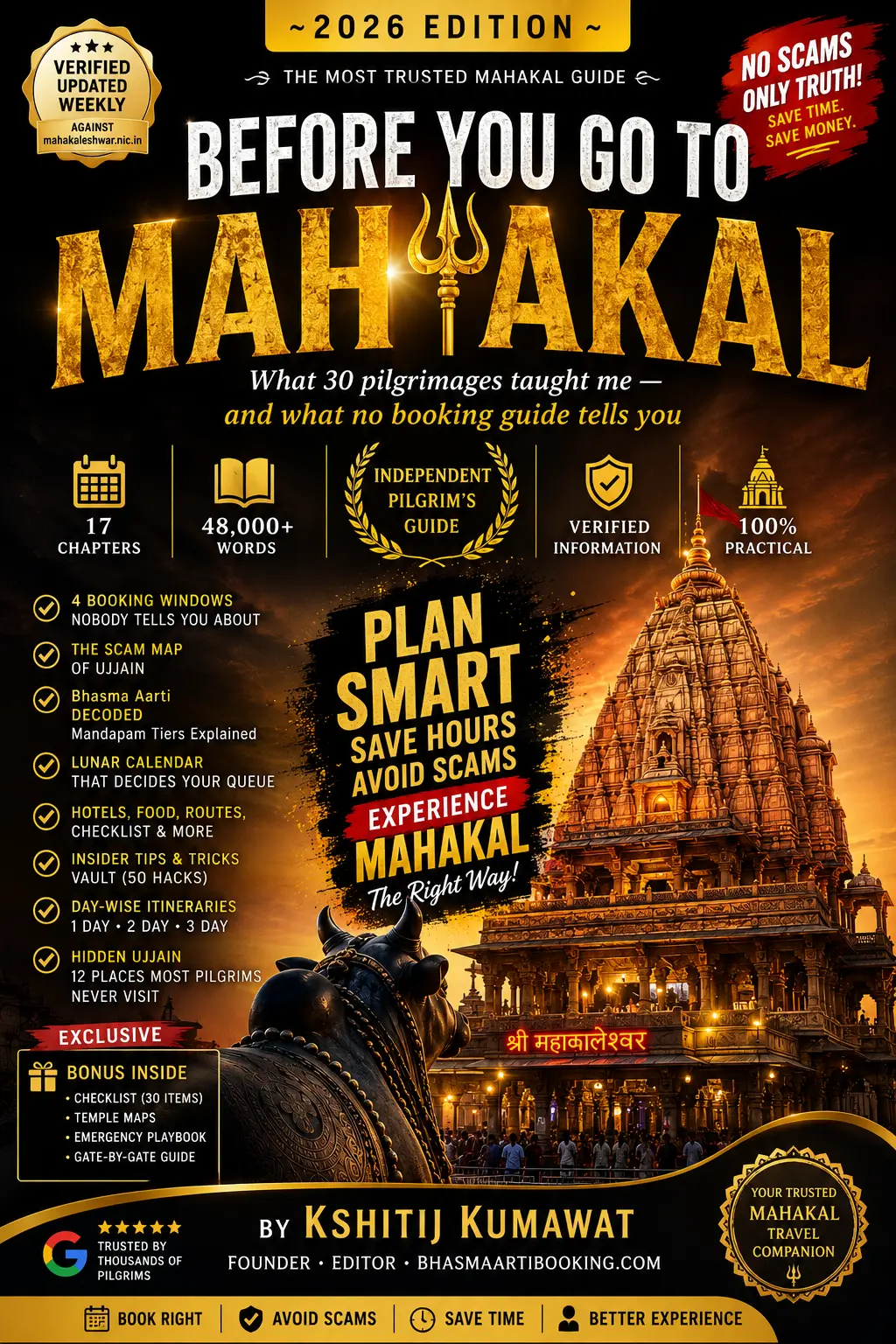
This silo of the site covers every part of the ritual in depth. Start with the timing and dress code if you are visiting soon. Read history and mandapam tiers if you are planning a meaningful pilgrimage. If you want the complete step-by-step booking strategy — including the four hidden booking windows and the tithi calendar that decides queue lengths — that is what the 120-page PDF Insider Playbook is for.
Bhasma Aarti Time
Exact 4 AM ritual schedule, seasonal variation, and gate-opening timeline.
Bhasma Aarti Dress Code
Men: dhoti, bare-chested. Women: saree only. Why no salwar-kameez is allowed.
Mandapam Tiers Explained
Nandi · Karthikeya · Ganesh · the full tier-by-tier price and view comparison.
History & Significance
The 2,000-year-old ritual of ash worship, its mythological roots, and why Mahakal alone.
Online Booking Process
How the official mahakaleshwar.nic.in portal works — booking windows, slot release.
Offline Booking at the Counter
Gate 4 admin counter, timings, documents required, step-by-step process.
Why Mahakal Alone Has Bhasma Aarti
Of the 12 Jyotirlingas in India — Somnath, Mallikarjuna, Mahakaleshwar, Omkareshwar, Kedarnath, Bhimashankar, Vishweshwar, Trimbakeshwar, Vaidyanath, Nageshwar, Rameshwaram, and Grishneshwar — only the Mahakal Jyotirlinga at Ujjain is honoured with a daily ash bath. Several mythological strands explain this. The most commonly retold is the tale of the demon Dushana, defeated by Shiva who emerged from the lingam itself; the ash on his body became the first bhasma offering. Another tradition holds that Mahakal, as the “Lord of Time and Death,” demands the ash of the cremation ground each dawn as a reminder to devotees of the impermanence of life.
The ritual's continuity is what makes it sacred. For at least 2,000 years — some historians argue much longer — the dawn ash offering at this exact site has not been interrupted. Even during the Mughal period, when the original lingam was destroyed by Iltutmish in 1235 CE, the ritual resumed within decades on a re-installed murti. To witness it is to step into a stream of devotion that has flowed unbroken since before the founding of most of the world's capitals.
How to Attend
There are two paths to attending the Bhasma Aarti: online booking through the official portal mahakaleshwar.nic.in (slots release 60 days in advance, midnight IST), and offline booking at the temple administration counter near Gate 4 the evening before. Both have their own quirks. Both have failure modes that catch first-time devotees off guard.
The complete operational guide — including the exact 4 booking windows, midnight refresh strategy, mandapam tier comparison with prices, scam patterns to avoid, gate map, dress code enforcement details, hotels within walking distance of Gate 4, and day-by-day itineraries — is in the 120-page PDF Insider Playbook (₹299). For free, navigate the topic pages above.
Continue your pilgrimage research
- Bhasma Aarti TimeExact 4 AM schedule and Gate 4 entry timeline.
- Bhasma Aarti Dress CodeDhoti for men, saree for women — why and what gets rejected.
- Mandapam TiersNandi vs Karthikeya vs Ganesh — price, view, who should book what.
- Online Booking — Step by StepHow mahakaleshwar.nic.in actually works — slot release, midnight refresh.
- Mahakaleshwar TempleThe Jyotirlinga, the south-facing lingam, and the daily aartis.
- The Insider Playbook — ₹299120-page operational guide to Bhasma Aarti and Ujjain pilgrimage.