History of Bhasma Aarti — 2,000 Years of Ash Worship
The Bhasma Aarti is the oldest continuously performed temple ritual in India. Its history spans the Mauryan and Gupta empires, the destruction of 1235 CE, the Maratha restoration of 1734, and the modern Mahakal Lok era. Below is the complete timeline.
Puranic Origins — The Dushana Legend
The Skanda Purana, in its Avantyakhanda section, narrates the original story of the Mahakaleshwar Jyotirlinga. The asura king Dushana terrorised the residents of the city of Avanti (modern Ujjain), forbidding them from worshipping Shiva. Five Brahmin devotees continued their puja in secret. When Dushana attacked them, the devotees called out to Shiva. The earth split open, and Shiva emerged in his terrifying Mahakal form — the destroyer of time itself.
Mahakal reduced Dushana and his armies to ash with a single roar. The Brahmins prayed that Shiva remain in Avanti permanently. He agreed, manifesting as a self-formed (svayambhu) lingam, and the ash of the slain demons became the first bhasma used to bathe him. From that day onward, the Mahakaleshwar Jyotirlinga has been adorned each morning with sacred ash — a ritual unique to this temple among all twelve Jyotirlingas.
Mahakal as Lord of Time
The name "Mahakal" literally translates to "Great Time" or "Lord of Time". In Hindu cosmology, Shiva in this form devours time itself at the end of each cosmic cycle. Ash — bhasma — is the final residue of all matter after time has consumed it. To bathe the lingam in ash is to acknowledge that Mahakal transcends the cycle of creation and destruction.
This is why the south-facing orientation of the Mahakaleshwar Jyotirlinga matters. South is the direction of Yama, the lord of death. Only Mahakal among all Jyotirlingas faces south — a defiant declaration that even death answers to him. The Bhasma Aarti is the ritual enactment of this metaphysical fact each dawn at 4 AM.
Mauryan and Gupta Era Worship
Archaeological and literary evidence confirms continuous worship at Mahakaleshwar from at least the 3rd century BCE. The Mauryan emperors patronised Ujjain as a major administrative centre — Ashoka served as viceroy of Avanti before becoming emperor. During the Gupta period (4th-6th century CE), Ujjain reached its cultural zenith. The poet Kalidasa, court poet of Vikramaditya, referenced the Mahakaleshwar temple in his Meghaduta, describing devotees performing evening aarti at the shrine.
During this golden age, the Bhasma Aarti was performed using ash from cremation grounds — specifically from the funerary pyres of the city. This practice marked Mahakaleshwar as fundamentally different from every other Shaivite temple in India. The Smarta tradition of using ash from the agnihotra fire was rejected here. Mahakal demanded the ash of the dead.
Iltutmish's Destruction, 1235 CE
In 1235 CE, the Delhi Sultan Shamsuddin Iltutmish marched on Ujjain. The Mahakaleshwar temple was demolished, the original lingam reportedly thrown into a nearby reservoir known as the Koti Tirth Kund, and idols of the surrounding shrines smashed. The Bhasma Aarti was suspended for the first time in over a millennium. Local Brahmin families preserved the rituals in private homes and at smaller shrines, waiting for restoration.
For nearly five centuries, worship at the main shrine was sporadic and clandestine. The temple remained in ruins through the Khilji, Tughlaq, Lodi, and early Mughal periods. Only during the reign of Akbar did some accommodation return — Hindu pilgrims could visit, but no major reconstruction occurred.
Maratha Restoration, 1734
The decisive turning point came in 1734, when Ranoji Shinde (Scindia), a senior general of the Peshwa, was granted Ujjain as a jagir. Ranoji's diwan Ramchandra Shenvi Baba commissioned the full reconstruction of the Mahakaleshwar temple in the Bhumija architectural style. The original lingam was recovered from the Koti Tirth Kund and reinstalled in the sanctum.
With the temple restored, the Bhasma Aarti was revived in its original form. The Shinde family established the still-functioning system of paid mandapam tiers, designated entry through what is now Gate 4, and a dedicated administrative office. For details on how the modern booking system descended from this 18th-century framework, see the online booking guide.
Colonial Period to Modern Era
Through the British Raj, the Scindia family retained control of the temple as maharajas of Gwalior. Ujjain remained part of the princely state until 1947. After Independence, the temple was placed under the management of the Mahakaleshwar Temple Committee, a body of trustees that continues to administer worship today.
The most dramatic recent change was the inauguration of the Mahakal Lok corridor in October 2022 — a 920-metre processional pathway with 108 ornate columns, 53 murals depicting Shiva legends, and integrated infrastructure for the millions of annual visitors. The corridor did not alter the Bhasma Aarti itself but vastly improved access logistics. See the temple structural history for the architectural specifics.
The Ritual Today
The Bhasma Aarti performed at 4 AM today is essentially the same ritual the Brahmins of the Skanda Purana described. The mantras — primarily from the Rudram Chamakam of the Yajurveda — have not changed. The conch shells, the bells, the damaru drums, and the ash itself follow protocols set down centuries ago. The only modern accommodations are the booking portal, the security screening, and the mandapam seating system.
One detail has changed: since 1984, the ash used is no longer drawn from cremation grounds but is ritually prepared from cow dung cakes burnt with specific Vedic mantras. This shift, made under public health concerns, has been accepted by the temple committee as ritually equivalent. Some traditionalists disagree, but the ritual's power and significance remain undiminished.
For the operational mechanics of attending the Bhasma Aarti today — from booking to dress code — see the main Bhasma Aarti guide, the exact timing reference, and the comprehensive Insider Playbook (₹299).
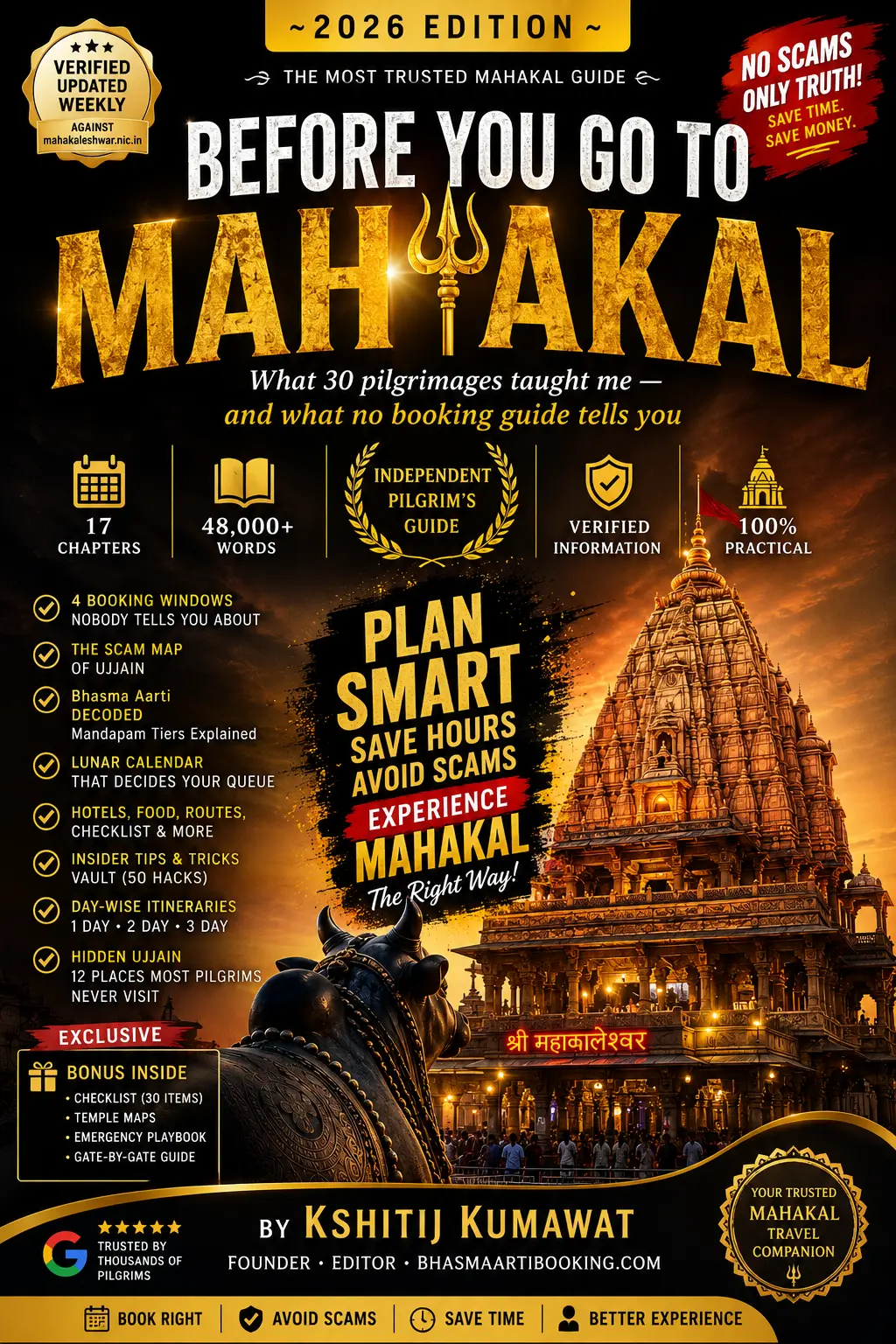
Continue your pilgrimage research
- Mahakaleshwar HistoryFrom Pradyumna to today — 2,000 years of continuous worship.
- Mahakaleshwar TempleThe Jyotirlinga, the south-facing lingam, and the daily aartis.
- Bhasma Aarti — Complete GuideThe 4 AM ash ritual at Mahakaleshwar, explained end to end.
- Bhasma Aarti TimeExact 4 AM schedule and Gate 4 entry timeline.
- Kal Bhairav TempleThe deity who drinks liquor — Ujjain's most unusual ritual.
- The Insider Playbook — ₹299120-page operational guide to Bhasma Aarti and Ujjain pilgrimage.